 Crosstown Lines
Why I'm building a tram game
I'm building a game where you run the trams of a real city. It's called Crosstown Lines, it's early, and I'd like to show it while it's still rough.
The idea
This one has been in my head for a while. Before I wrote any game code, I built a small HTML prototype just to see whether a city map made of blocks, with lines drawn over it, looks and feels right. It did, so I started the real thing.
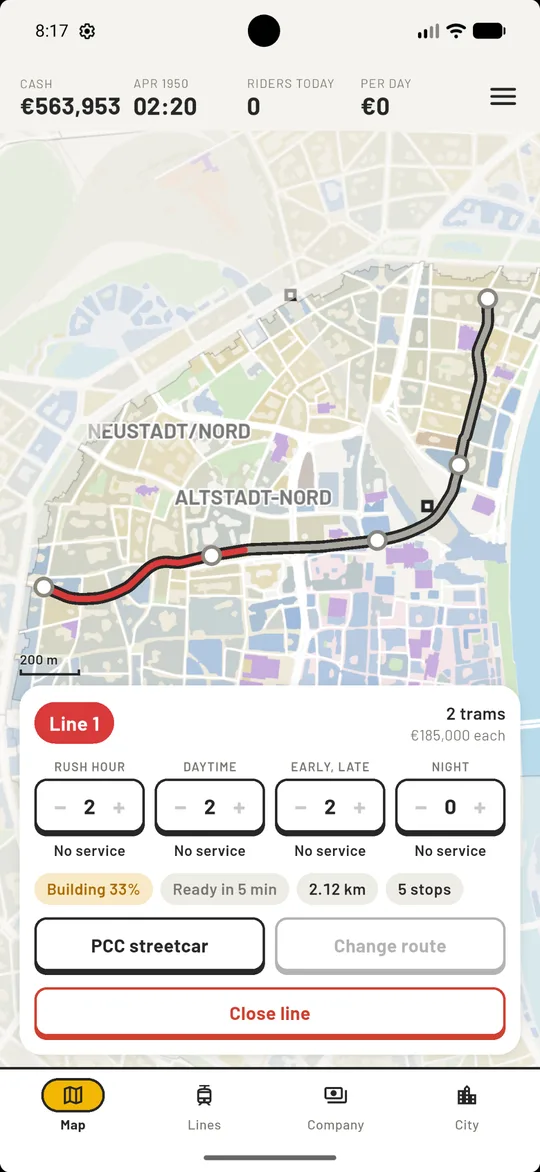
You get a real city map, you draw a line along the real streets, you put stops on it, and trams start to run. Then you find out whether anyone wants to ride them. That's the whole loop, and I want it to stay readable.
The first city is Cologne, because that's where I live and I can check the map against what I see outside. More cities will come later.
One game day is one real hour
This was the first decision I had to make, and I went back and forth on it. Real time is too slow, because you would wait weeks to afford a second line. Fast-forward buttons are the usual answer, but this is a phone game. You open it, do something, put the phone away and come back later.
So a game day lasts one real hour, and there are no speed buttons. The trams keep running while the game is closed. When you open it again, the game works out what happened in between and tells you. That catch-up is capped at 24 game days, so a long break doesn't turn into a huge pile of numbers.
Plan first, then build
Before you pay for a line, the game shows a forecast: roughly how many people it will carry and what it will cost to run. Building then takes real time, around two minutes per kilometre. I didn't want building to be instant, but I also didn't want it to feel like a chore.
You can place a stop anywhere on the track. No buying plots, no land. You do need a licence for each district you want to build in, so a new city isn't open all at once.
A map made of blocks
The map comes from OpenStreetMap. I don't draw single houses. The game groups them into blocks, and each block knows how many people live there, how many work there and how dense it is. Big named buildings keep their real outline, so you can find them.
The reason is practical. The closest zoom is about 500 metres across, and the whole city has to load quickly on a phone. Blocks keep the file small.
What's not done
A lot. The economy is tuned mostly with a bot that plays the game, and a bot is not a person. I will only know if the numbers feel right once I put it on my own phone and play it for real. That's the next step, through TestFlight.
The game will have no account and no ads, and games stay on your device. There will be a shop for more cities, but nothing in it should be needed to play.
I'll write down what changes as it goes. The next note is about what's new this week.
Crosstown Lines is a work in progress. Everything described here can still change.